Why Sprinklers Suddenly Fail After Years of Working Fine
Sprinklers suddenly failing after years of working fine? Learn how to diagnose low pressure in one zone, missing heads, and leaks after spring startup.
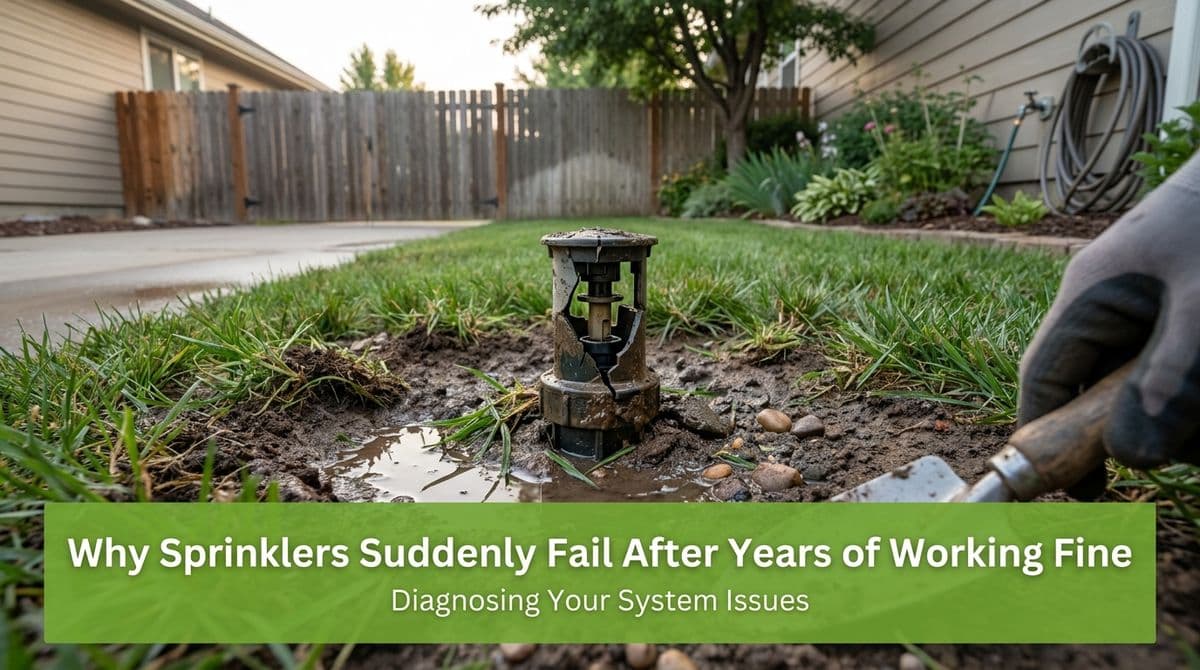
When a Sprinkler System Suddenly “Has a Year”
We recently got a call from a homeowner — let’s call him Mike — who was more than a little frustrated with his sprinkler system (and honestly, we couldn’t blame him).
Mike had done everything right. He blew out his system in the fall like he’d been doing for 30 years, turned it back on in the spring, and then suddenly:
- One zone had very low pressure
- Another zone was missing a head entirely — just a big hole in the ground
- His lawn was starting to burn up while he waited for help
His question to us was basically: “How can everything work fine for years, and then one spring it all goes south?” If that sounds familiar, this guide is for you. We’ll walk through what usually causes these sudden failures after years of smooth operation, what you can safely troubleshoot yourself, and when it’s time to call in a pro.
Why Sprinklers Fail After Years of Working Fine
From what we saw with Mike — and many others — sprinkler systems rarely fail for just one reason. It’s usually a mix of age, weather, and a few unlucky breaks that all show up the same spring.
1. Winter heave and ground movement
Even when the system is properly blown out in the fall, our freeze–thaw cycles can shift the soil and move pipes, fittings, and heads around. Over time that can:
- Crack older pipe or fittings
- Push heads too low (they stop popping up fully)
- Pull a head loose so it eventually blows off and disappears
That’s probably what happened with Mike’s “big hole in the ground where a head used to be.” Nothing obvious changed on the surface, but the ground was slowly working against the system for years.
2. Normal wear on valves and zone piping
Each zone is controlled by an electric valve and a specific run of pipe. After years of use, valves can start to stick or partially close, and fittings can develop small leaks. You might not see anything for a long time, then one spring you notice:
- Low pressure in one zone only
- Heads in that zone barely spraying or not rotating
- Wet, mushy ground when that zone runs
That’s exactly what Mike described: one zone with very low pressure that used to work perfectly.
3. Hidden damage during non-watering months
Things can also happen when the system is off:
- Snowplows or vehicles roll over shallow lines or valve boxes
- Dogs or kids kick, twist, or break exposed risers and heads
- Landscaping projects nick or crush pipes
By the time spring startup rolls around, it can feel like everything chose the same year to “take a dive,” but usually the problems were building slowly.
How to Diagnose a Single Zone With Low Pressure
Mike’s biggest concern was that one weak zone. When just one zone has low pressure, that’s actually good news — it narrows down the likely culprits. Here’s how we recommend homeowners start troubleshooting.
Step 1: Compare zones
Turn on each zone one at a time:
- If every zone is weak, you may have a main supply, backflow, or master valve issue.
- If only one zone is weak, focus on that valve and its piping.
Step 2: Check for visible leaks
With that low-pressure zone running:
- Walk the line and look for water bubbling or flowing where it shouldn’t.
- Feel for soft, squishy spots in the lawn.
- Check around valve boxes for standing water.
A strong leak underground can “steal” most of a zone’s pressure before it even reaches the far heads.
Step 3: Inspect the valve (if accessible)
If you’re comfortable opening a valve box:
- Make sure the zone valve is fully open and not stuck halfway.
- Listen — a constant hissing or spraying sound in the box can mean an internal leak.
At this point, if the issue isn’t obvious, we usually recommend a professional diagnosis. Locating and repairing underground leaks often requires specialized tools and experience to avoid making a bigger mess.
What to Do About Missing or Broken Sprinkler Heads
Mike also had a head that had completely vanished — he joked that it was probably “on the moon somewhere.” More often, a missing or badly broken head means the riser snapped off below ground or the head slowly loosened and finally blew off.
When you can DIY a head replacement
If you’re fairly handy, you can usually tackle a straightforward head replacement yourself:
- Turn off the water to the system.
- Dig a neat, wide hole around the opening to expose the fitting and pipe.
- Unscrew any remaining riser/fitting and replace it with a matching head and nozzle.
- Backfill carefully and adjust the head so it’s level with the lawn.
The key is using the right parts. As Mike pointed out, some systems use odd sizes (like certain 3/4" poly fittings) that big box stores don’t always carry. If you open it up and the parts don’t look familiar or standard, it’s safer to pause and call a pro before forcing something that might crack the pipe.
When a “simple” head issue isn’t simple
Call a professional if:
- Water gushes up under pressure when the zone runs
- The hole keeps filling with muddy water as you dig
- More than one head in the zone is broken or missing
- You suspect the pipe itself is broken, not just the head
In those cases, we’re usually dealing with a cracked lateral line or a fitting that needs to be cut out and replaced correctly.
Spring Startup, Fall Blowouts, and Preventing Future Surprises
Mike mentioned he blows out his system himself every fall and has for decades. That’s great — proper winterization is one of the best ways to extend the life of a system. But even with perfect blowouts, things can still shift or wear out.
Smart steps for spring startup
Each spring, we recommend homeowners:
- Pressurize slowly instead of snapping the main valve fully open.
- Run each zone individually and watch every head.
- Look for uneven spray patterns, heads that don’t pop all the way up, or water pooling.
Catching problems early can save your lawn from the “burning up while you wait for service” situation Mike found himself in.
When to call a pro instead of DIY
We’re big believers in homeowners doing what they’re comfortable with. But from years in the field, here’s where professional help is usually worth it:
- Low pressure in a single zone and no obvious leak on the surface
- Multiple zones acting up at once
- Anything involving the backflow preventer or main shutoff
- Repairs that require cutting and gluing or fusing pipe
- Weird or non-standard fittings and pipe sizes
In Mike’s case, with one weak zone, a missing head, and a lawn already starting to burn, the best move was to get our crew out quickly, diagnose the leaks, match the right parts, and get his system back online before he lost more of his yard.
Need Help With a Suddenly Failing Sprinkler System?
If your sprinklers worked fine for years and this is the year everything decided to “take a dive,” you’re not alone. We see it every season at spring startup — one zone with low pressure, a random head that’s vanished, maybe a hidden leak soaking one corner of the lawn.
Use the tips above to do a quick check of your own system. If you’re not finding the problem, or you’d rather not dig up your yard chasing a leak, we’re here to help. We can track down low-pressure issues, replace missing or broken heads, and make sure your system is ready to keep your grass green all season long.